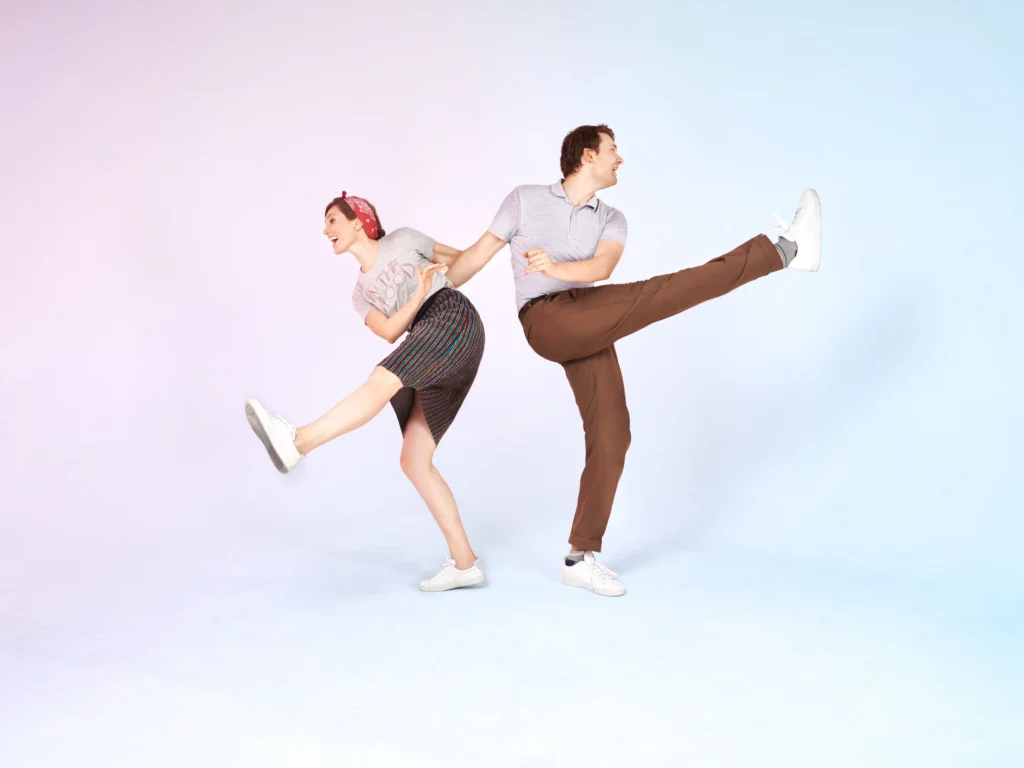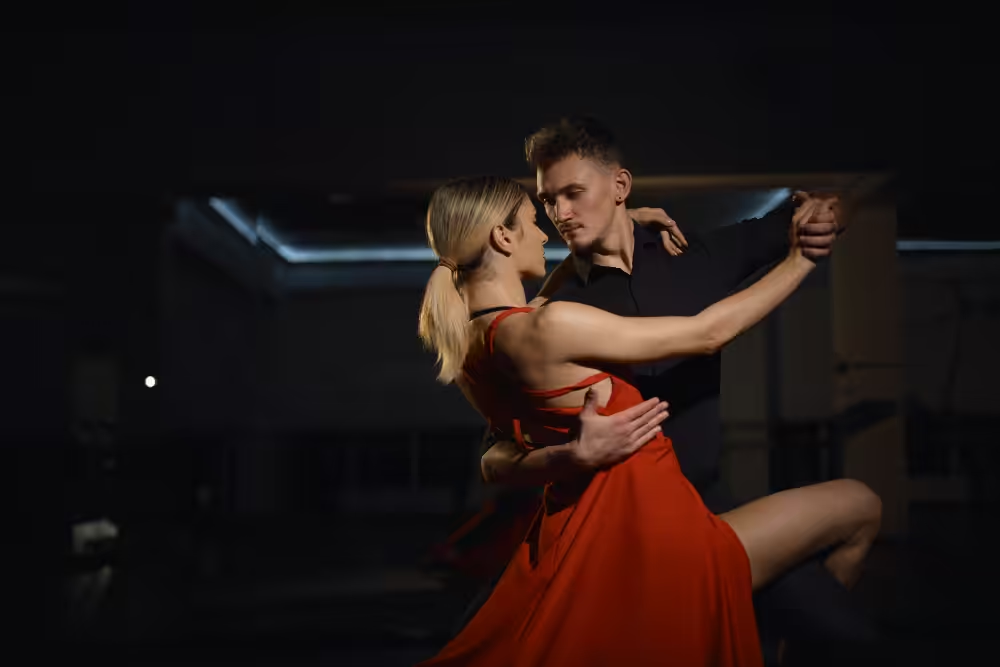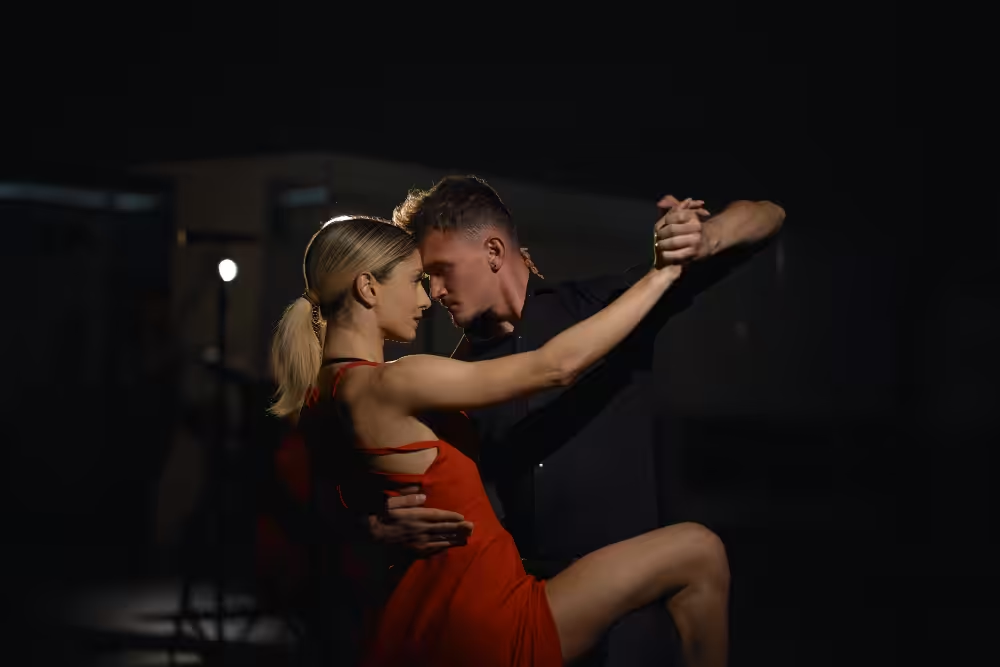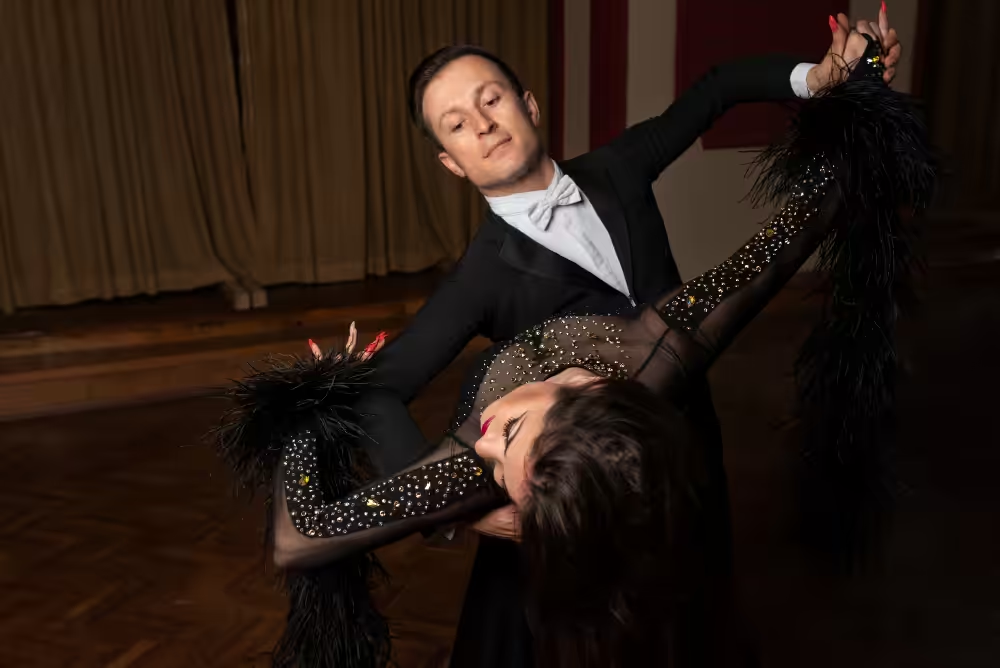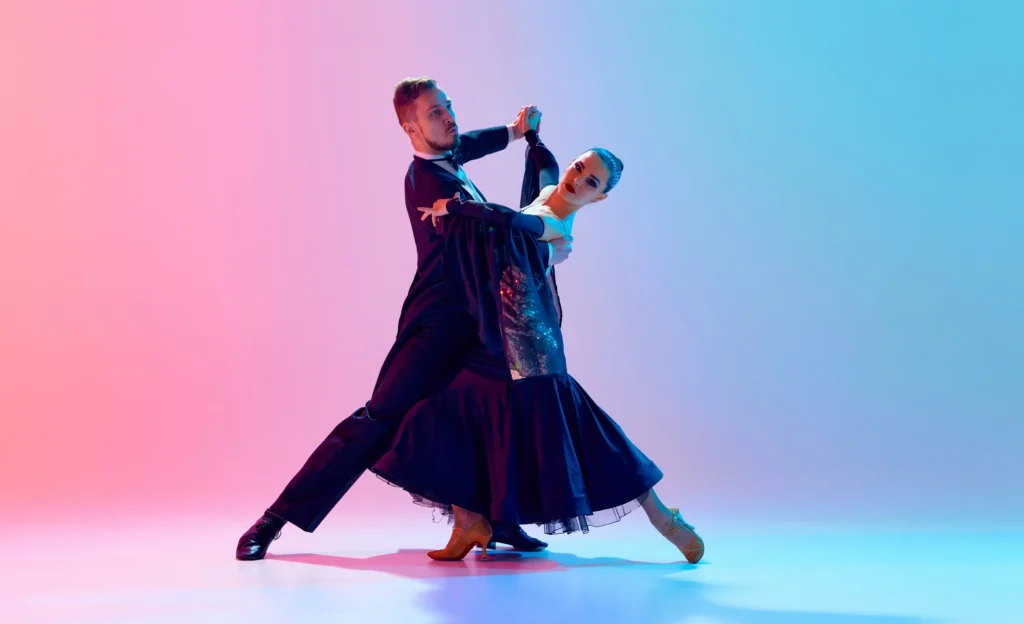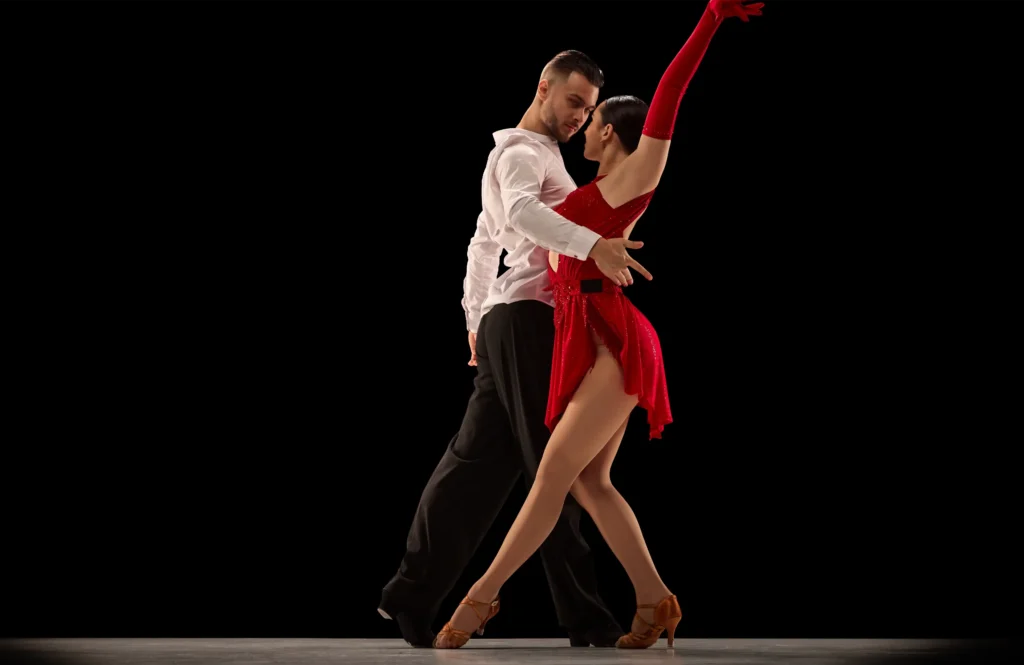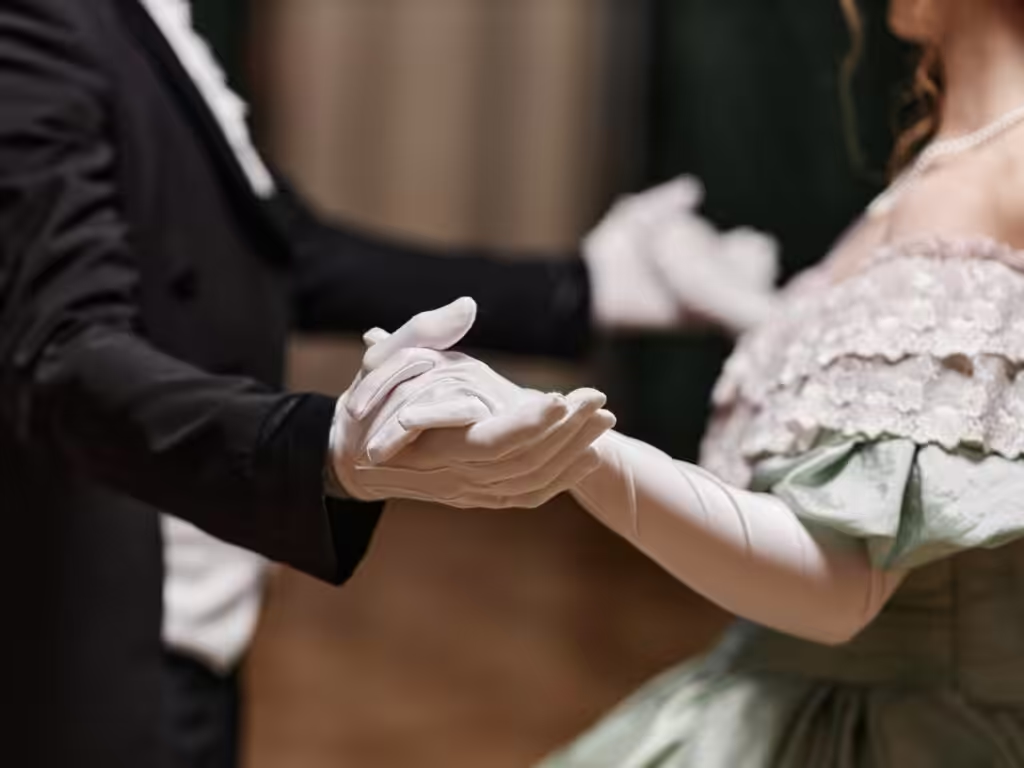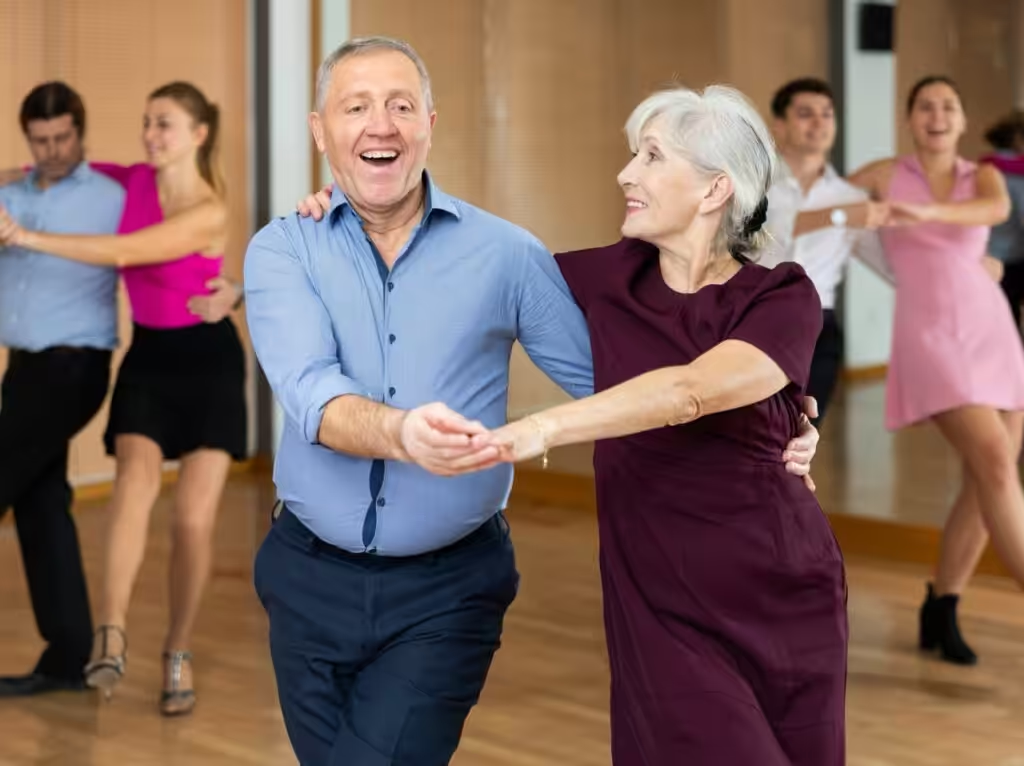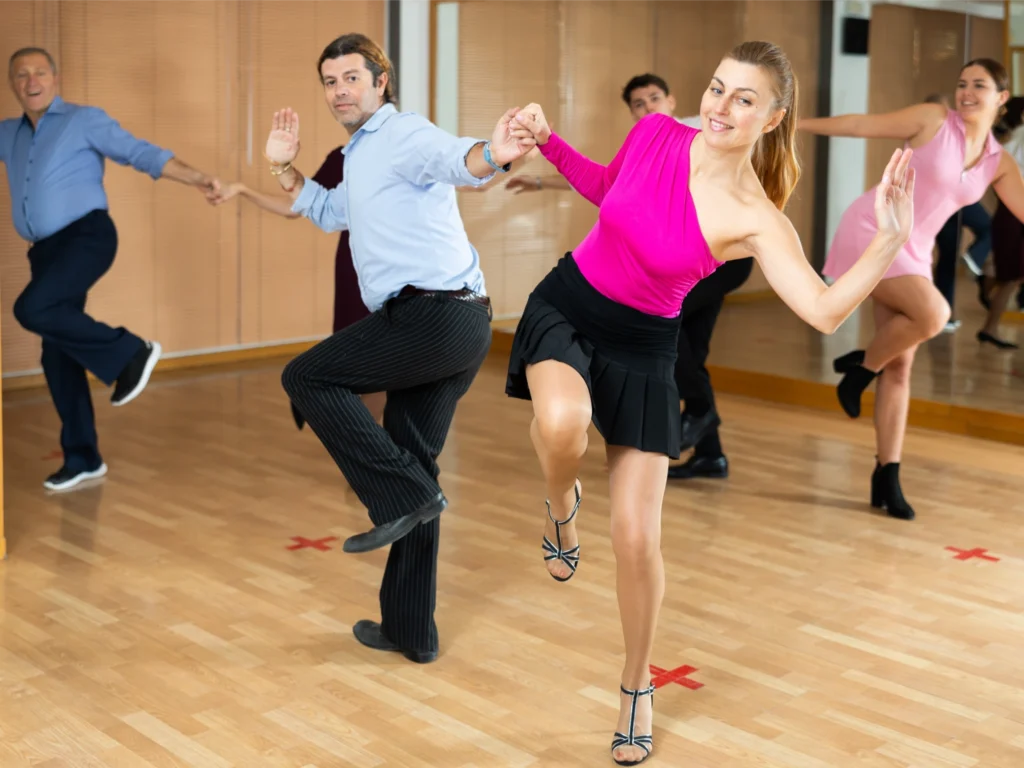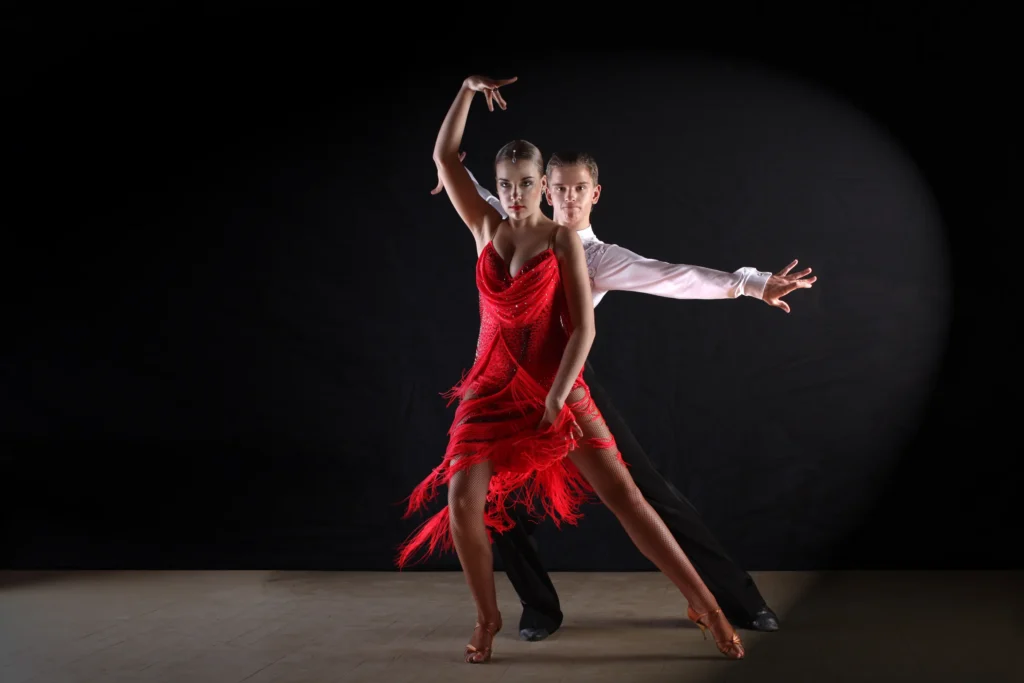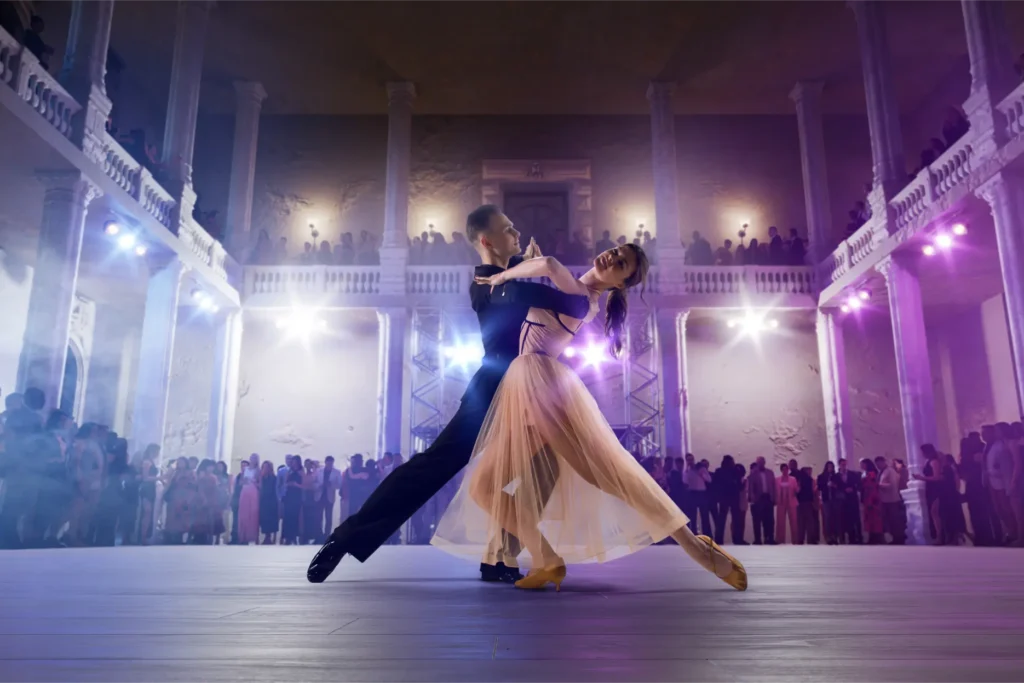
Quickstep is a fast-paced ballroom dance that developed in the 1920s from the Foxtrot, Charleston, Peabody, and other popular social dances. Today, it is known for its quick footwork, light hops, and smooth movement. It is one of the most energetic styles in ballroom dancing.
Key Takeaways
- British dance teachers formalized Quickstep into a competitive ballroom dance.
- The 1927 Star Championships helped establish Quickstep as its own dance style.
- Chassés and continuous rise and fall became defining elements of the technique.
- Quickstep follows a “Slow, Quick, Quick” rhythm in 4/4 time.
- It remains a staple of International Standard competitions and social ballroom dancing.
The History of Quickstep
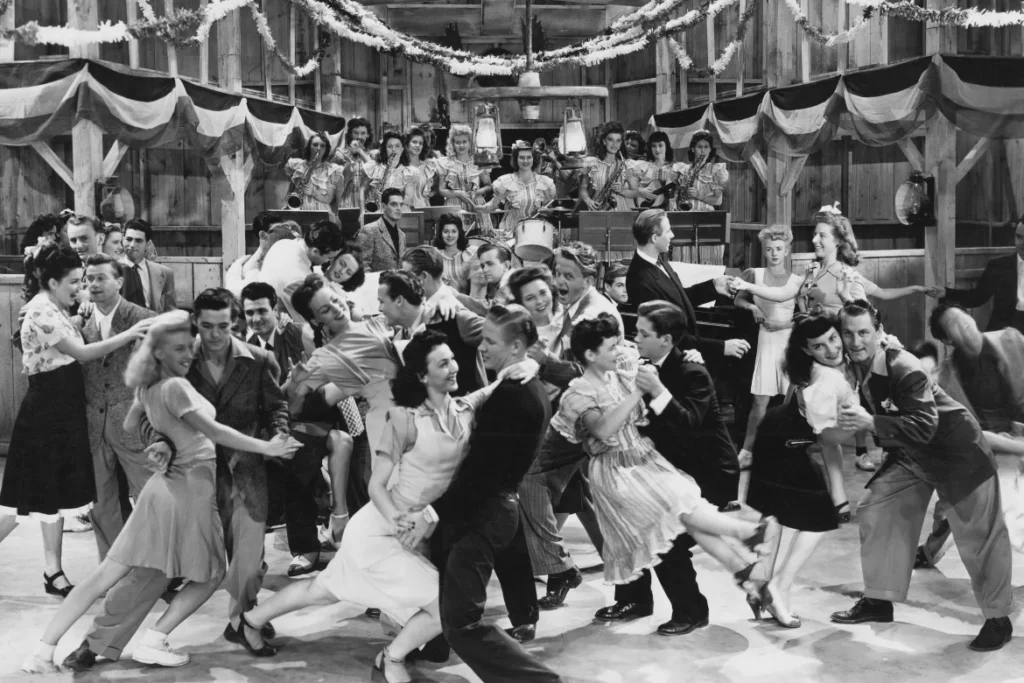
The history of Quickstep began in the United States during the 1920s, when faster jazz music changed the way people danced. As big bands increased the tempo, dancers adapted existing styles to match the music, laying the foundation for the ballroom dance known today.
The Foxtrot Foundation and Accelerated Tempos
Before the Quickstep dance claimed its own identity, the Slow Foxtrot reigned supreme in high society ballrooms. Developed in the 1910s by vaudeville actor Harry Fox, the original Foxtrot was smooth, linear, and danced to a moderate rhythm.
However, as ragtime transitioned into jazz, bandleaders discovered that audiences loved high-energy music. When the bands drastically sped up the tempo, the long, sweeping glides of the standard Foxtrot became physically impossible to execute comfortably.
Dancers had to shorten their strides, rise onto the balls of their feet, and adapt their movements to survive the frantic musical pace.
The Impact of the Charleston and the Peabody
As dancers adapted to the faster jazz tempos, they began pulling steps from popular street dances of the era. The biggest influence came from the Charleston, which introduced a frantic, infectious energy characterized by outward kicking motions and sharp syncopations.
While the wild, flailing arms of the solo Charleston were too chaotic for a closed ballroom frame, dancers cleverly adapted its rhythmic footwork into a more compact, partnered format.
Additionally, a dance called the Peabody—named after a New York police captain—contributed rapid, crossing side-steps that allowed couples to navigate crowded dance floors quickly.
The Synthesis of the One-Step
The final major ingredient in this stylistic evolution was the One-Step, a straightforward, fast-paced dance where a couple took one step for every beat of music. It required very little formal training but demanded incredible stamina.
By blending the smooth progression of the Foxtrot, the rhythmic playfulness of the Charleston, the swift spatial navigation of the Peabody, and the unyielding speed of the One-Step, a completely fresh hybrid style was born on American shores.
How Quickstep Became a Ballroom Dance
Britain transformed Quickstep from an informal social dance into a standardized ballroom style. During the late 1920s, American jazz bands introduced faster music to the United Kingdom, where British dance teachers refined the steps, established formal techniques, and created the version of Quickstep used in competitions today.
The Star Championships of 1927
A pivotal moment occurred during the 1927 Star Championships in England. Organizers noticed that couples trying to dance to the ultra-fast music were presenting a messy mix of different techniques.
Some danced a sped-up Foxtrot, while others performed a pure Charleston. To resolve this identity crisis, the Imperial Society of Teachers of Dancing (ISTD) stepped in to officially separate the disciplines.
They established two distinct categories: the Slow Foxtrot, which kept its smooth and romantic character, and a new, high-tempo category initially called the “Quick-Time Foxtrot and Charleston.”
Refining the Flight Technique
Once the dance was recognized as an independent discipline, British masters set out to standardize its rules. They stripped away the wilder, unanchored kicks of the Charleston to maintain a sophisticated, elegant ballroom posture, but they intentionally preserved its rhythmic complexity.
The defining breakthrough was the formal integration of the chassé—a triple-step pattern where one foot chases the other (step-close-step)—which allowed couples to move across the floor with incredible speed. They also emphasized a continuous rise-and-fall action, giving the dance its signature appearance of floating effortlessly through the air.
Why Is It Called Quickstep?
As the “Quick-Time Foxtrot and Charleston” phrase proved quite a mouthful for commentators and competitors alike, the name was quickly shortened.
By late 1928, the term was officially simplified to just one word. This renaming marked the formal birth of a standardized, international ballroom classic that would soon capture the imagination of competitive dancers around the globe.
What is the Quickstep?
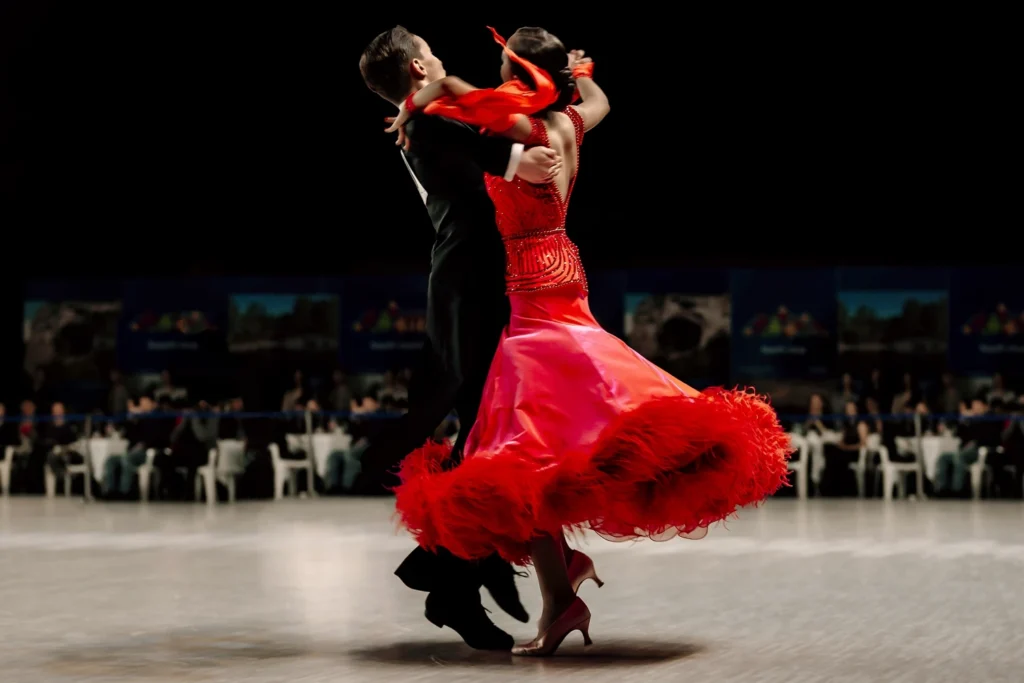
Quickstep is a fast-paced International Standard ballroom dance performed in 4/4 time. Its technique combines rapid footwork, continuous movement, and an upright ballroom frame.
Physically, it is easily the most demanding of the five International Standard ballroom dances, requiring the athletic stamina of a sprinter hidden beneath a mask of absolute elegance and poise.
Quickstep Core Structure
At its competitive core, the dance is set to a strict 4/4 time signature, played at a blistering tempo of 50 to 52 bars per minute. The foundational rhythm follows a “Slow, Quick, Quick” structure, where “Slow” steps take up two full beats of music and “Quick” steps occupy a single beat. This constant variation between long, sustained strides and sudden, rapid movements creates a highly visual, syncopated contrast on the dance floor.
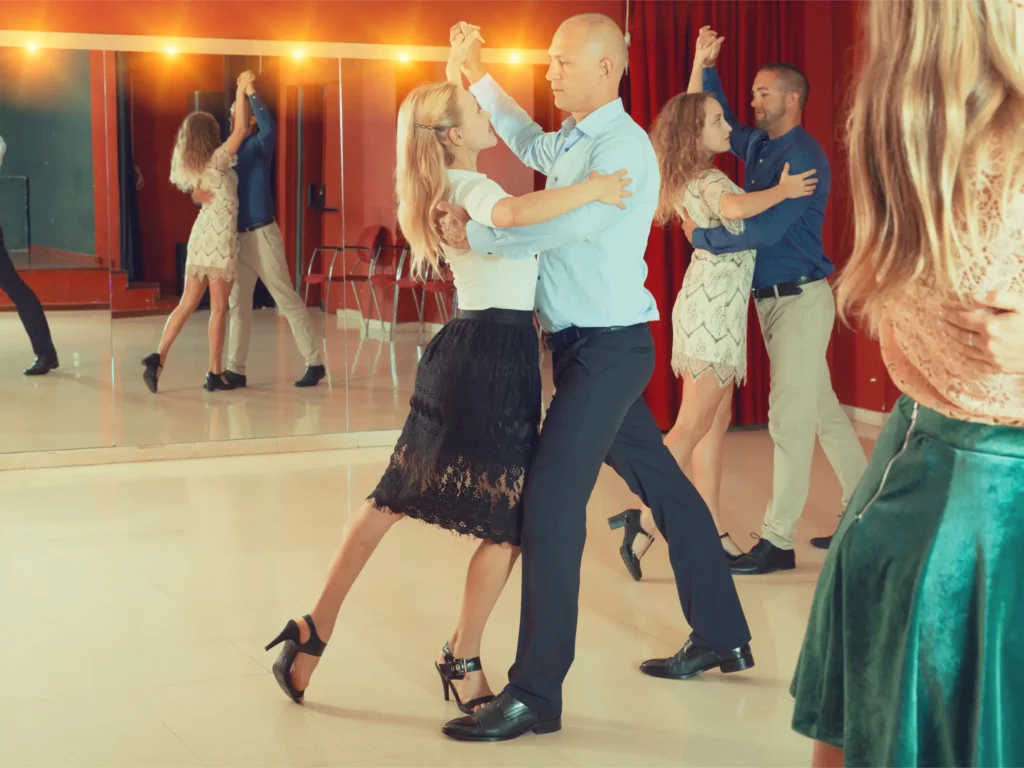
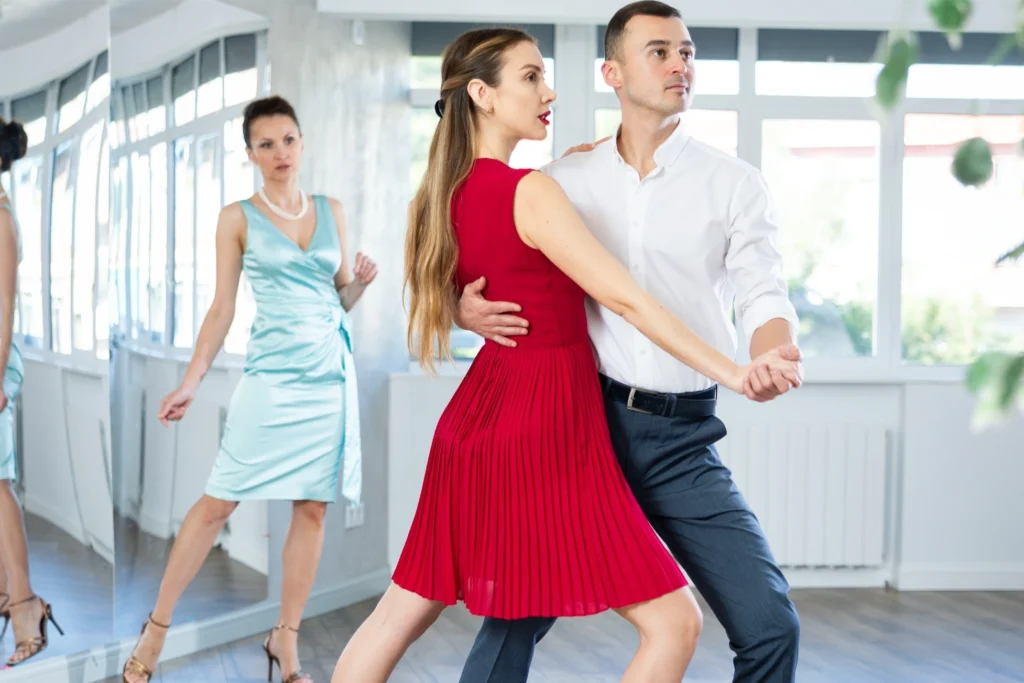
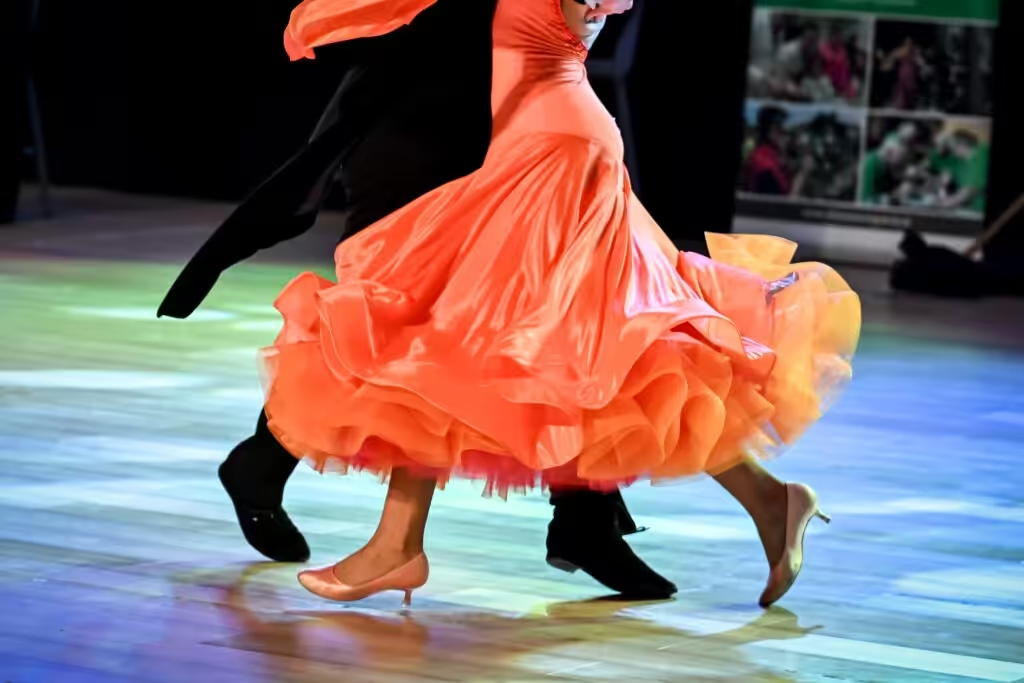
The technique relies heavily on keeping a tight, closed frame. Partners must maintain constant body contact from the hips up to the lower chest, moving as a single, unified unit. While their upper bodies remain perfectly still, calm, and regal, their legs and feet work at a furious pace underneath. It is this specific contrast—an immovable, elegant upper body paired with incredibly fast, precise footwork—that makes the discipline uniquely breathtaking to observe.
How to Learn the Quickstep
A century after its initial conception, this classic style continues to thrive. It remains a crowning highlight of prestigious international competitions, such as the Blackpool Dance Festival, and routinely steals the spotlight on popular television programs like Dancing with the Stars and Strictly Come Dancing.
Modern competitors have pushed the physical boundaries of the dance further than its creators ever imagined. Today’s routines incorporate advanced “points,” dramatic locks, and complex syncopated skips where both partners appear to lose contact with the floor entirely for fractions of a second. This illusion of weightlessness makes it an enduring fan favorite worldwide.
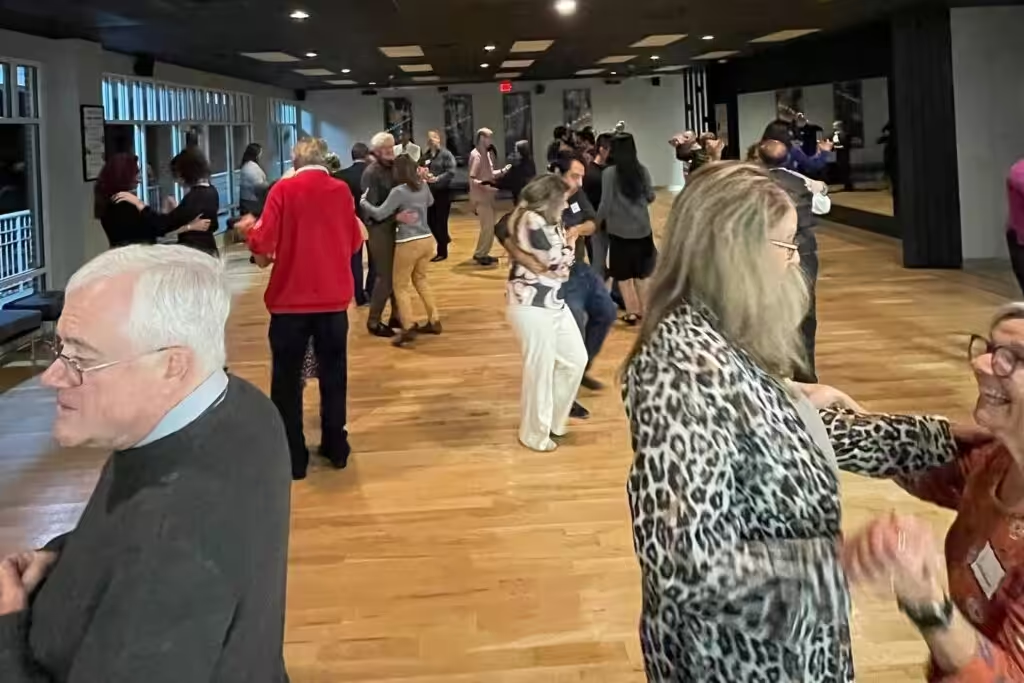
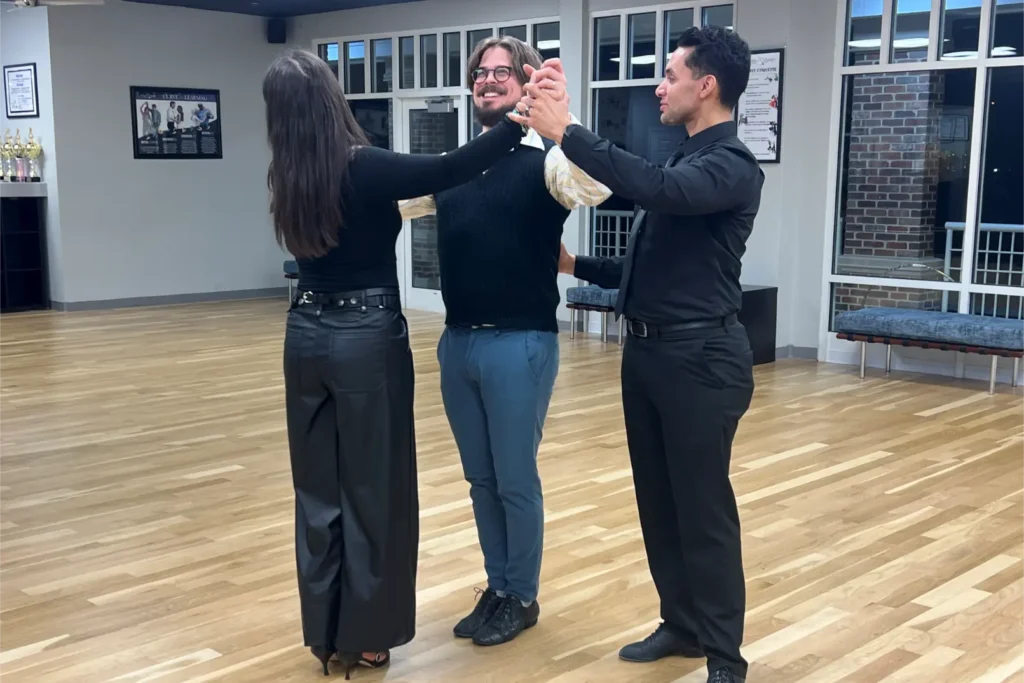
You do not need years of experience to start learning Quickstep in Princeton Junction, NJ. At Arthur Murray Dance Center, our instructors break Quickstep down into simple, manageable lessons. Whether you are preparing for a special event, exploring ballroom dancing for the first time, or looking for a fun way to stay active, our personalized instruction makes learning Quickstep both enjoyable and rewarding.
FAQs
What is the main difference between the Foxtrot and the Quickstep?
The primary difference is the musical tempo and the core movement style. The Foxtrot is danced to slower music (around 28-30 bars per minute) and features long, continuous, gliding walks. The Quickstep is danced to much faster music (50-52 bars per minute) and features bright, syncopated footwork, including hops, skips, and rapid chassés.
Is the Quickstep difficult for beginners to learn?
Because of its fast pace, it can feel intimidating at first. However, the foundational steps—such as the quarter turns and progressive chassés—are straightforward. Once a beginner learns to manage their balance and timing at a slower speed, increasing the tempo becomes a fun and highly rewarding progression.
What kind of music is used for this dance?
Traditionally, it is danced to fast big band, swing, and jazz music from the 1920s through the 1940s. In modern social and competitive settings, instructors also utilize upbeat contemporary pop tracks, musical theater numbers, and jazz revivals, provided they maintain the necessary 4/4 time signature and speed.